Interactive Visual Anatomy · Studio 02
How to Read Any Thangka or Mandala, Pin by Pin
Every Tibetan scroll painting is an exact visual map—never random decoration. Select a museum masterwork below and tap any numbered mineral-gold pin (1–6) on the canvas.
Read along the central vertical axis from top sky (ultimate lineage) → center heart (principal Buddha) → lower courtyard (earthly protection & narrative).
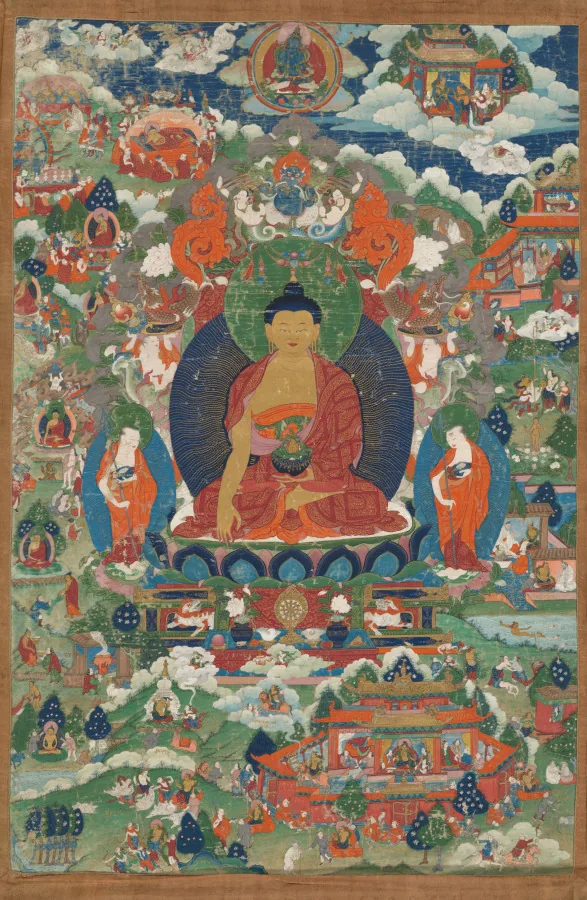
Canonical Three-Register Thangka Composition (Lineage, Yidam & Protectors) · c. 1700 · Tibet · The Cleveland Museum of Art (1917.889) (CC0 1.0)
Sky Apex · Primordial Vajradhara & Lineage Source
Seated inside a five-colored rainbow sphere at 12 o’clock, azure Vajradhara marks the unbroken origin of the teaching, flanked at upper right by Maitreya’s Tuṣita heaven pavilion.
Read full guide: Ādi-Buddha: Samantabhadra & Vajradhara →Read from the innermost hub outward across four concentric rings, then step outside Yama’s claws to see the Buddha pointing to liberation.
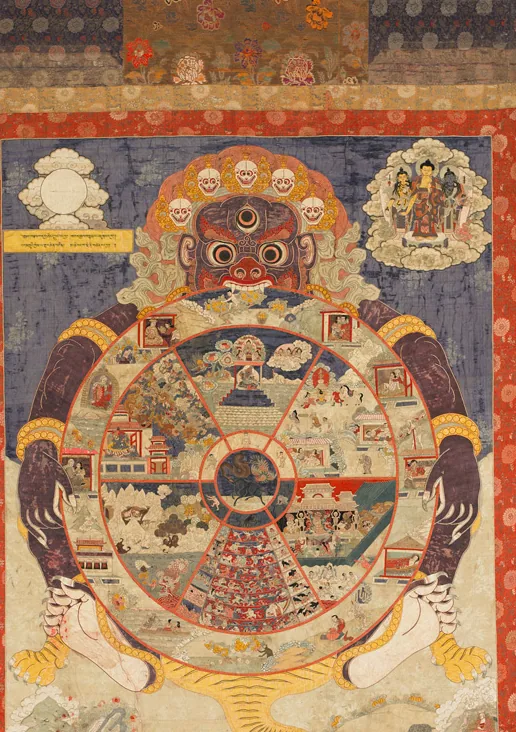
Bhavacakra: The Four-Ringed Wheel of Conditioning and Liberation · 19th century · Eastern Tibet · Rubin Museum / Open Public Domain Archive (Public Domain)
Fierce Holder · Impermanence (Yama)
Wearing a crown of five dry skulls, wrathful Yama clutches the entire disc—meaning every conditioned realm inside his arms is transient, moment by moment.
Read full guide: Yamāntaka / Vajrabhairava →A painted mandala is a 2D architectural floorplan of a 3D multi-story awakened palace—enter from the outer flame ring through the Eastern (bottom) gate to the central lotus.
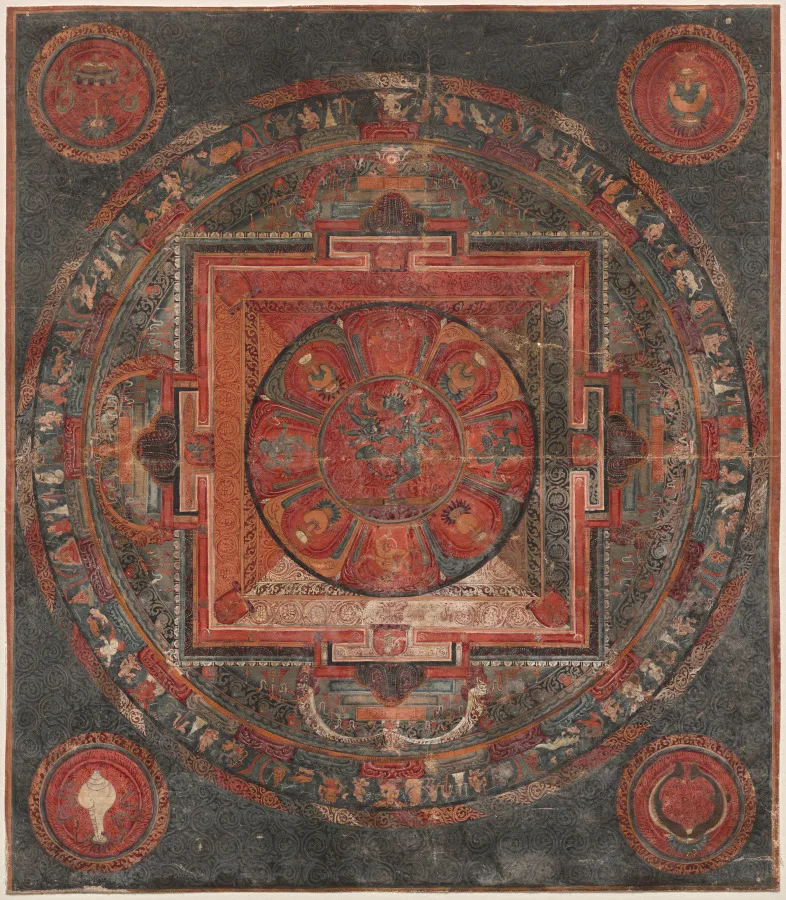
Mandala of Cakrasaṃvara and Vajravārāhī Ringed by Eight Charnel Grounds · Late 15th century · Central Tibet · The Cleveland Museum of Art (1960.211) (CC0 1.0)
Central Sanctum · Cakrasaṃvara & Vajravārāhī
At the axis mundi of the palace, 12-armed azure Cakrasaṃvara embraces crimson Vajravārāhī—representing the indivisibility of great bliss-compassion and emptiness.
Read full guide: Cakrasaṃvara →Two linked mandalas mirror the subtle human body: the lower sphere maps the 42 Peaceful Deities at the heart center; the upper sphere maps the 58 Wrathful Deities at the crown.
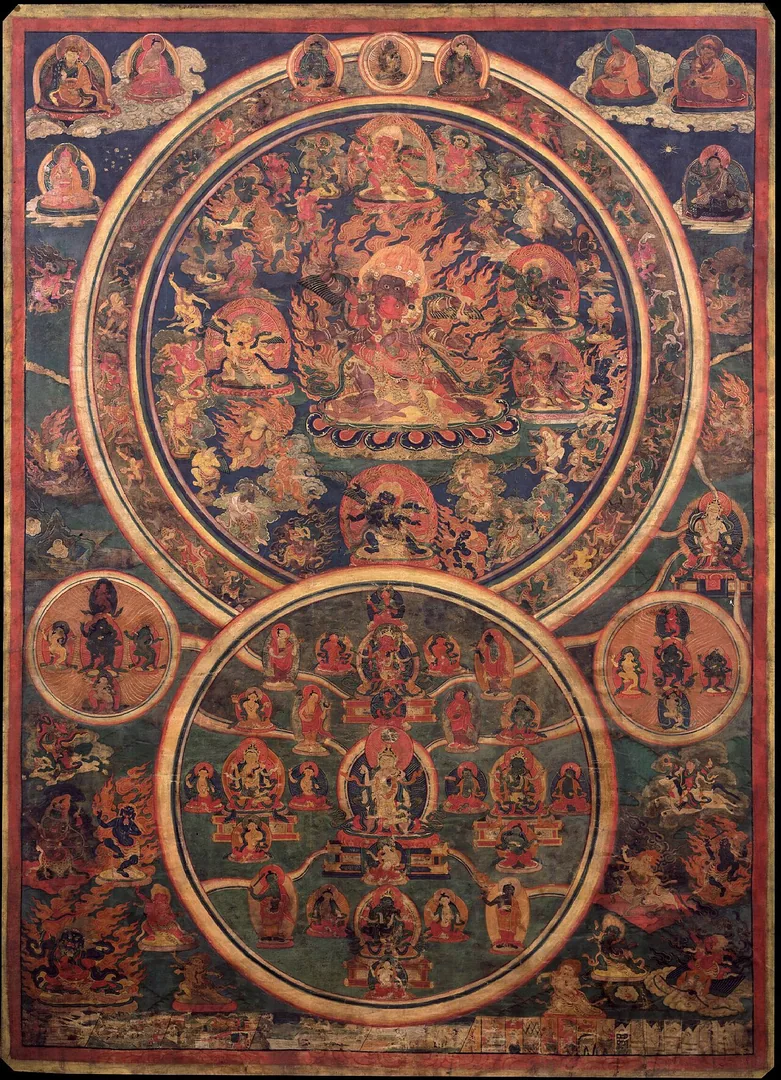
Mandala of the Peaceful and Wrathful Deities (Zhitro) of the Bardo · 18th–19th century · Nyingma Karling Zhitro Tradition · Himalayan Art Public-Domain Archive (Public Domain)
12 O’Clock Crown · Primordial Samantabhadra
Unadorned Dharmakāya Buddha at the summit of the painting—symbolizing pure timeless awareness (rigpa) before confusion or enlightenment split apart.
Read full guide: Ādi-Buddha: Samantabhadra & Vajradhara →