The Heart Sūtra (Sherab Nyingpo · 心经)
Full Classical Text & Plain-Language Passage Companion
In 260 Chinese characters (and a slightly longer framed dialogue in the Tibetan Kangyur), Avalokiteśvara explains to Śāriputra why seeing emptiness—interdependent openness—dissolves fear.
Why Tibetan Editions Are Slightly Longer Than the 260-Character Version
Readers encountering the Tibetan Sherab Nyingpo (Toh 21) are often surprised to see it open with “Thus have I heard—at one time the Blessed One was dwelling at Rājagṛha on Vulture Peak…” In the Tibetan (and Sanskrit long) recension, the Buddha enters a profound meditation called Profound Illumination, Śāriputra asks how one should train in deep wisdom, Avalokiteśvara answers with the famous discourse on emptiness, and the Buddha emerges from meditation at the end saying “Well spoken, well spoken!” Xuanzang’s 260-character Chinese text preserves the luminous core of Avalokiteśvara’s answer.
Passage-by-Passage Companion (Classical Text & Plain Meaning)
Read “emptiness” (śūnyatā) carefully: it never means nothing matters or nothing exists. It means nothing exists all by itself—everything is woven of changing conditions, which is precisely why rigid fear can loosen.
觀自在菩薩,行深般若波羅蜜多時,照見五蘊皆空,度一切苦厄。
When Noble Avalokiteśvara practiced deep Perfection of Wisdom, he saw clearly that the five aggregates are empty of independent nature, thus crossing beyond all distress.
Body, feelings, perceptions, habits, and consciousness (the five aggregates) are fluid processes, not a solid prison.
舍利子!色不異空,空不異色;色即是空,空即是色;受想行識,亦復如是。
Śāriputra, form is not separate from emptiness, emptiness is not separate from form; form itself is emptiness, emptiness itself is form. The same holds for feeling, perception, formation, and consciousness.
You don’t find peace by escaping everyday life into a void; interdependence is right inside ordinary things.
以無所得故,菩提薩埵依般若波羅蜜多故,心無罣礙;無罣礙故,無有恐怖,遠離顛倒夢想,究竟涅槃。
Because there is nothing to cling to as fixed gain, bodhisattvas rely on deep wisdom and abide with unhindered minds. Having no hindrance, they are free of fear, far beyond upside-down projections, resting in peace.
The emotional core of the sutra: night-time terror comes from mistaking anxious mental movies (“upside-down dreams”) for solid fate.
揭諦揭諦,波羅揭諦,波羅僧揭諦,菩提薩婆訶。
Gate gate pāragate pārasaṃgate bodhi svāhā — Gone, gone, gone across, gone altogether across: awakening, may it take root!
Notice “pārasaṃgate” (gone across together): awakening is never a solo escape.
How It Is Practiced in Living Tradition
Copied by hand in calligraphy for calm concentration, chanted across both East Asian and Tibetan monasteries, and read quietly when the mind feels crowded.
Common Questions & Clarifications
Is it disrespectful to read the Heart Sūtra late at night?
That rumor is modern internet folklore with zero basis in either Tibetan Kangyur or Chinese Vinaya canons. Monasteries chant the Heart Sūtra at both dusk and pre-dawn.
Primary Sources & Further Reading
- CBETA Taishō T0251 (Xuanzang) & Kangyur Toh 21 (Vimalamitra & Rinchendé)
- Donald S. Lopez Jr., Elaborations on Emptiness: Uses of the Heart Sūtra (Tibetan commentaries)
Connected in the Mandala Graph
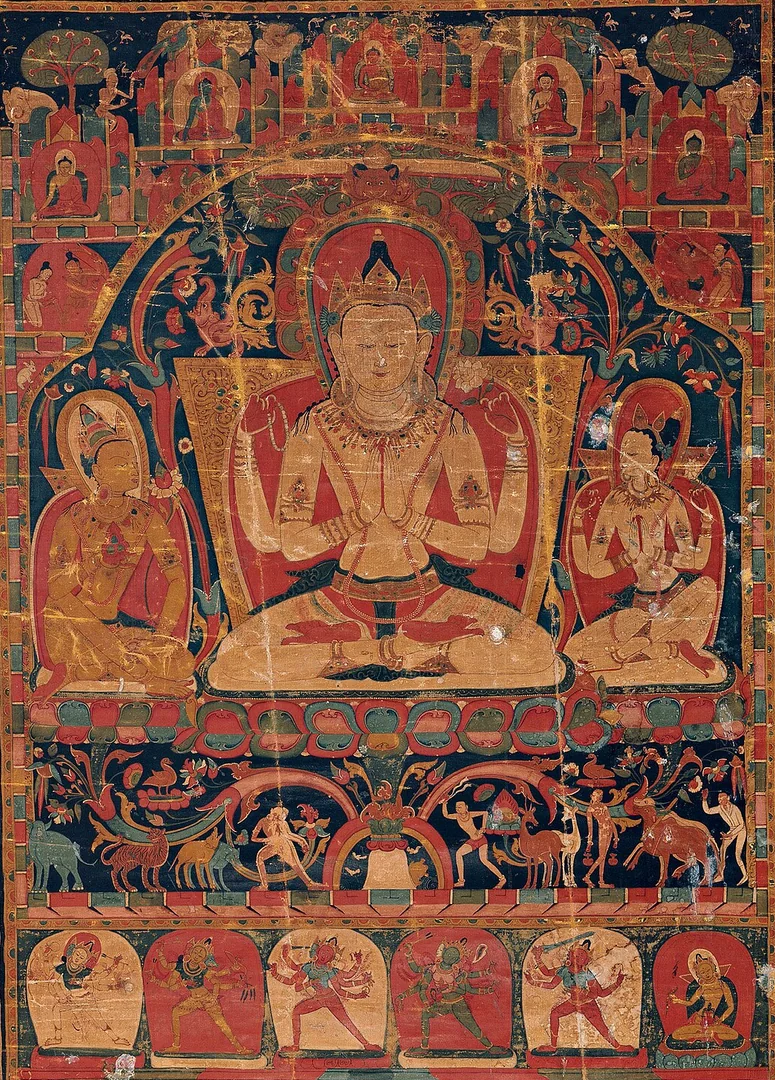
Avalokiteśvara (Chenrezig)
Known in Tibetan as Chenrezig (“One Who Gazes with Unwavering Eyes”), the four-armed white form embodies impartial compassion united with emptiness, associated with the Six-Syllable Mantra Oṃ Maṇi Padme Hūṃ.
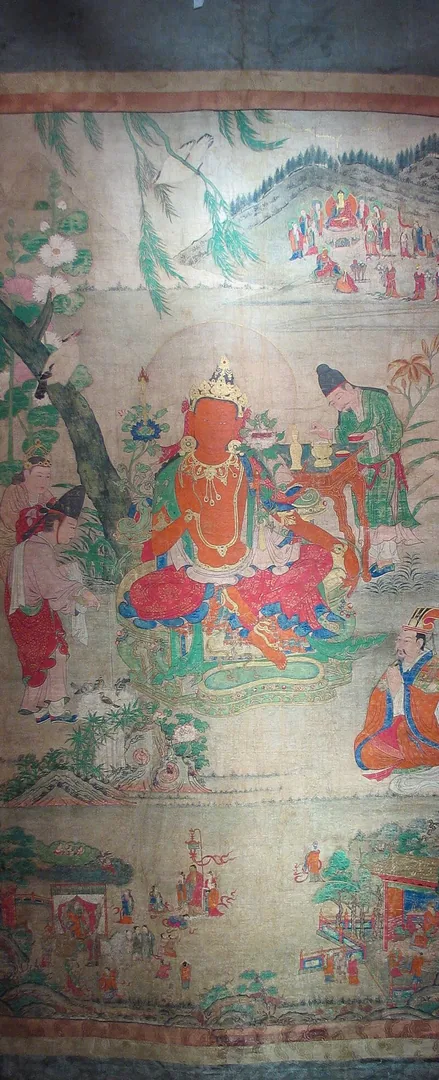
Mañjuśrī (Jampelyang)
Radiant saffron-gold in hue, Mañjuśrī raises a blazing sword overhead with his right hand to slice right through conceptual confusion, while holding the Prajñāpāramitā Sūtra on a lotus at his heart.
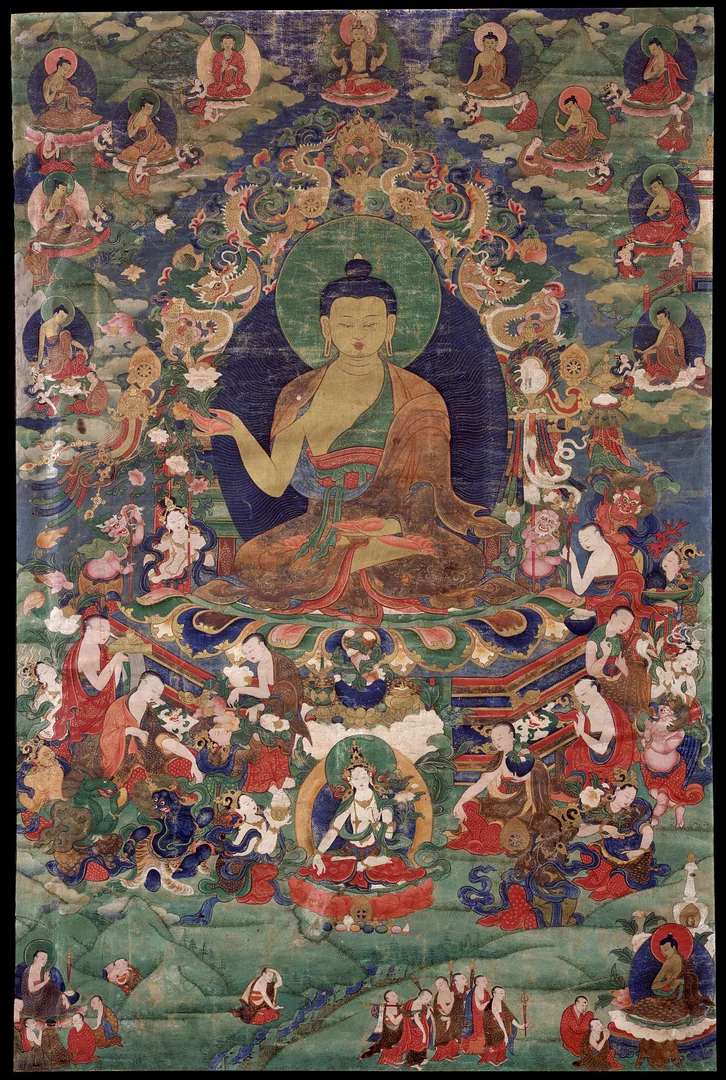
Śākyamuni Buddha (Shakya Thubpa)
Known in Tibetan as Shakya Thubpa (“Mighty Sage of the Śākyas”), the historical Buddha sits in unadorned monastic robes, touching the earth with his right fingertips to witness impartial awakening while cradling an iron alms bowl in his lap.
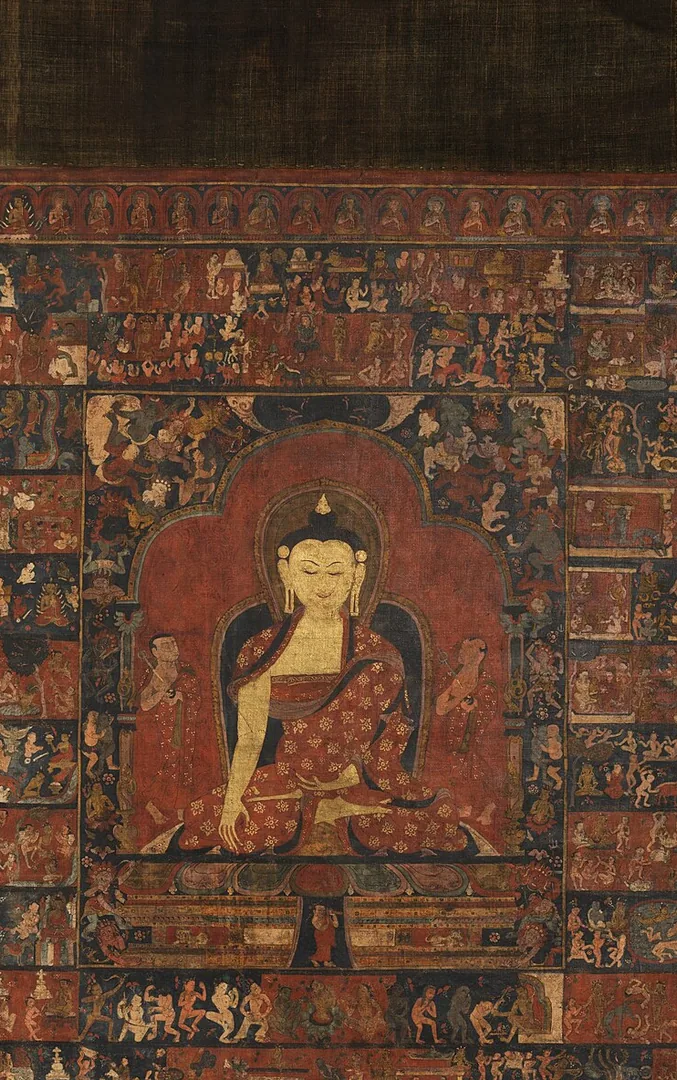
Karma & Interdependence: Why It Is Never Fatalism
In Sanskrit and Tibetan (las), karma literally means “action,” never “predestined fate.” While past choices shape today’s conditions, how one responds right now writes the next cause.