The Five Buddha Families & Five Wisdoms (Rigs-lnga)
Why Vajrayāna Transmutes Difficult Emotions Instead of Suppressing Them
Known in Tibetan as Gyalwa Rig-nga, the Five Buddha Families organize every mandala color, direction, element, and deity around one radical psychological premise: the raw energy inside our five most painful emotions is the exact same energy as the Five Awakened Wisdoms.
Clear Energy Twisted by Grasping: Why Emotions Are Not “Sin”
Anyone who has tried to become peaceful merely by clamping down on anger or longing knows what happens: suppressed emotion goes underground and hardens into tension or hypocrisy. Tibetan Vajrayāna psychology offers a startlingly modern diagnosis. Every klesha (afflictive emotion) consists of two things fused together: (1) vivid, intelligent natural energy, and (2) dualistic ego-grasping that hijacks that energy.
Consider anger: when ego hijacks it, anger lashes out to wound; yet strip away self-centered defensiveness and look straight at anger’s raw texture—it is razor-sharp, awake, crystal-clear refusal of confusion! In Tibetan manuals, that purified clarity is called Mirror-Like Wisdom: just as a clean mirror reflects everything vividly without getting stained or agitated by what appears in it.
Complete Correspondence Map of the Five Families
Once you hold this fivefold key, every color in a Tibetan mandala, prayer flag, or deity thangka becomes immediately legible:
中央佛部 · 毗盧遮那佛(大日如來)|純白 · 空/法界|轉「愚痴麻木」為「法界體性智」
Center · Buddha Family (Vairocana) · White · Space — Transmutes spaced-out ignorance (moha) into All-Encompassing Dharmadhātu Wisdom.
Instead of numbing out or shutting down, awareness rests in vast, uncontrived openness.
東方金剛部 · 阿閦佛(不動如來)|青金藍 · 水/堅固|轉「嗔恚憤怒」為「大圓鏡智」
East · Vajra Family (Akṣobhya) · Lapis Blue — Transmutes aggression and aversion (dveṣa) into Mirror-Like Wisdom (ādarśa-jñāna).
Sharp precision without hostility; seeing situations cleanly as they are, like still water.
南方寶生部 · 寶生如來|雌黃純金 · 地大|轉「傲慢匱乏」為「平等性智」
South · Ratna (Jewel) Family (Ratnasambhava) · Golden Ochre · Earth — Transmutes pride and superiority/inferiority into Wisdom of Equanimity (samatā-jñāna).
Arrogance actually masks insecurity; grounded richness recognizes equal dignity in every being.
西方蓮花部 · 阿彌陀佛(無量光)|朱砂紅 · 火大|轉「貪愛執取」為「妙觀察智」
West · Padma (Lotus) Family (Amitābha) · Vermilion Red · Fire — Transmutes grasping desire (rāga) into Discriminating Wisdom (pratyavekṣaṇā-jñāna).
Warm appreciation and empathetic care for particulars without needy clinging (Avalokiteśvara & Padmasambhava belong here).
北方羯磨部 · 不空成就佛|孔雀石綠 · 風大|轉「嫉妒焦慮」為「成所作智」
North · Karma (Action) Family (Amoghasiddhi) · Malachite Green · Wind — Transmutes envy, comparison, and frantic control (īrṣyā) into All-Accomplishing Wisdom (kṛtyānuṣṭhāna-jñāna).
Restless competitiveness relaxes into effortless, timely action—embodied most famously by Green Tārā.
How It Is Practiced in Living Tradition
Applied in everyday mindfulness whenever a strong emotion flares: pausing to feel its bodily energy directly without acting out the storyline, recognizing which of the five families is speaking.
Common Questions & Clarifications
Does “transforming emotions into wisdom” mean acting out anger or desire impulsively?
Never—Tibetan masters warn sharply against that self-serving excuse. Acting out an emotion reinforces ego-habit; transmutation happens only when one drops the storyline and rests directly in ungrasped awareness.
Primary Sources & Further Reading
- Sarvatathāgatatattvasaṃgraha (Compendium of Principles of All Tathāgatas, Toh 479), Kangyur
- Thrangu Rinpoche, Transcending Ego: Distinguishing Consciousness from Wisdom (Nāropa’s & Rangjung Dorje’s treatises)
Connected in the Mandala Graph
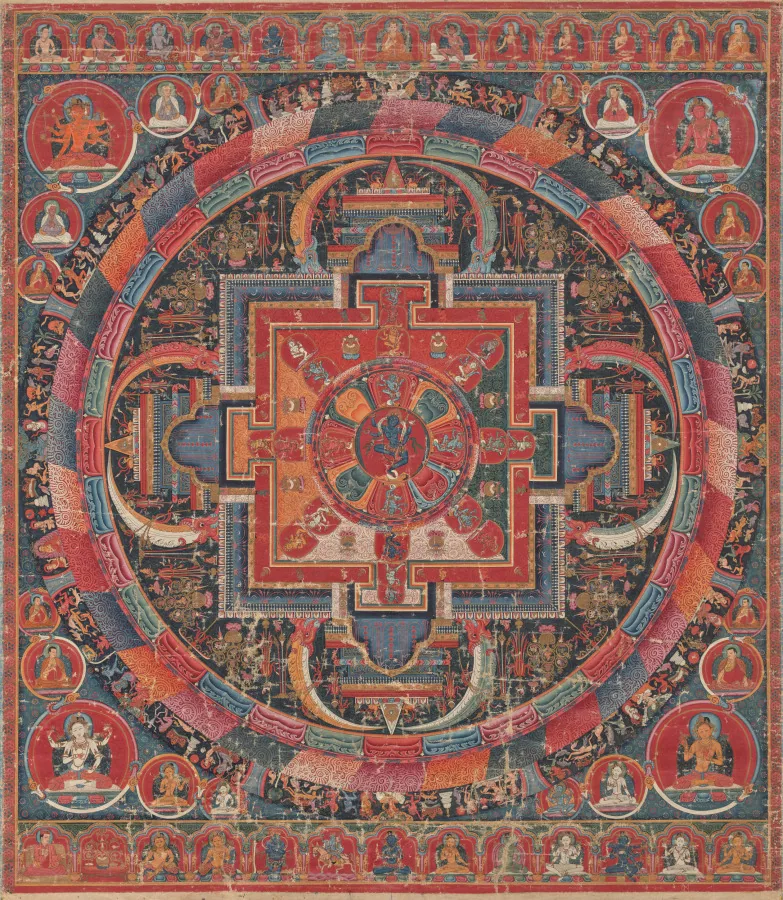
The Mandala (Kyilkhor · དཀྱིལ་འཁོར།)
Rendered in Tibetan as dkyil-’khor (“center and periphery”), a mandala is not decorative symmetry—it is a two-dimensional architectural floor plan of an awakened three-dimensional palace.
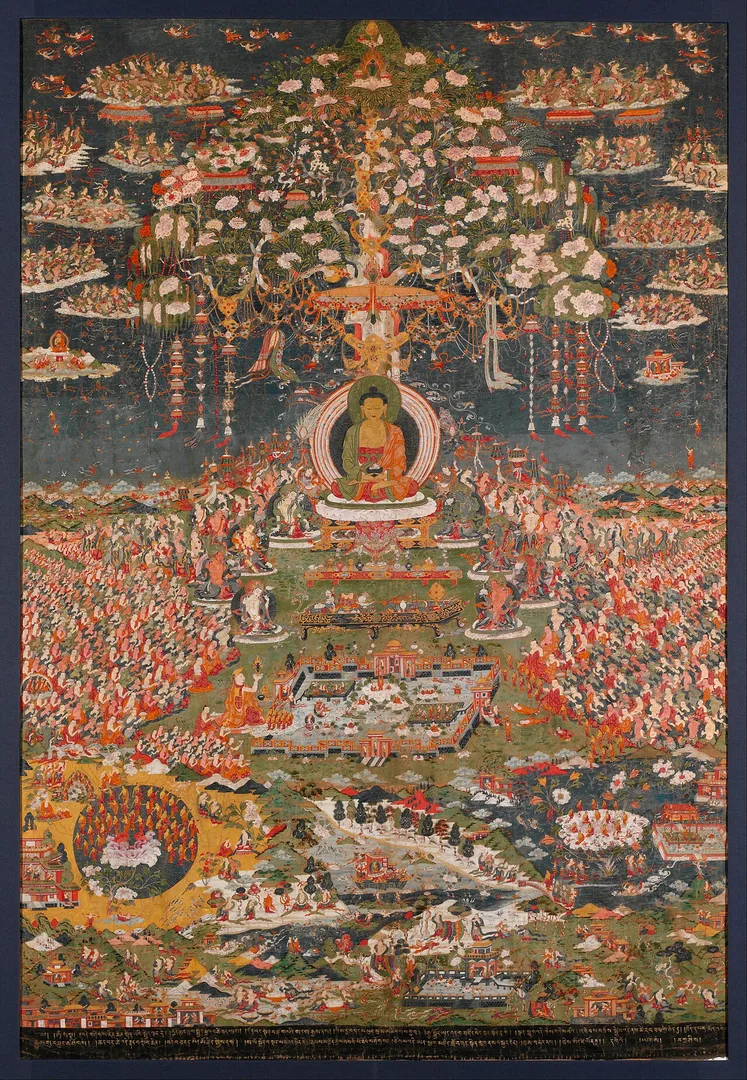
Amitābha (Öpakmé · Buddha of Infinite Light)
Radiating warm sunset-ruby red in the West of the Tibetan mandala, Amitābha (“Infinite Light,” Tibetan Öpakmé) rests both hands in meditation equipoise cradling an alms bowl of ambrosial nectar (amṛta), presiding over the Lotus Family to which Chenrezig and Padmasambhava belong.
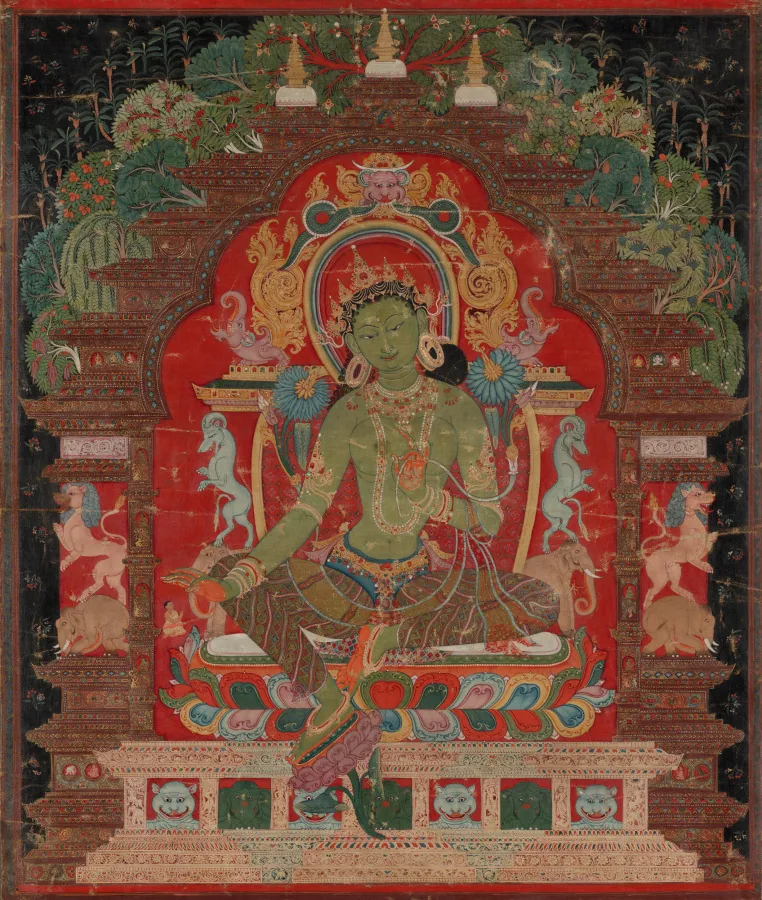
Green Tārā (Sgrol-ljang)
Seated in royal ease with her right foot already stepping off the lotus cushion, Green Tārā embodies enlightened compassion in immediate motion—green being the color of the Wind/Action Buddha Family.
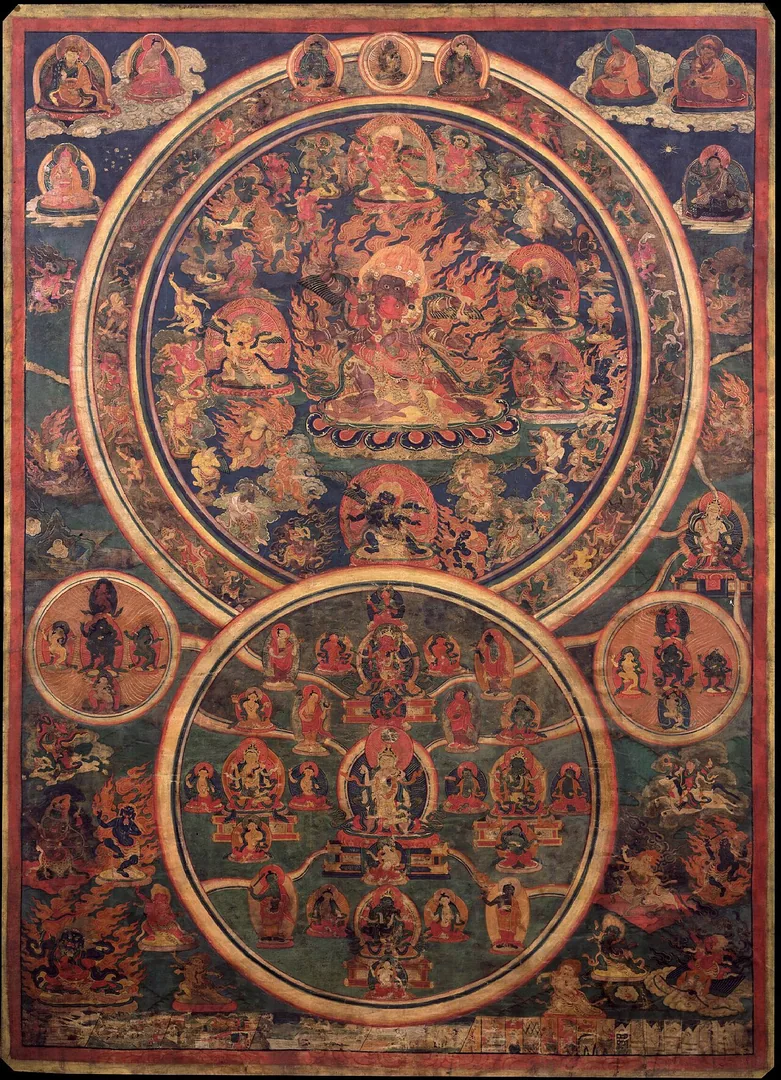
Bardo: The Six In-Between States
Literally “interval between two things” (bar-do), the famous Tibetan Book of the Dead (Bardo Thödol) maps not only death and rebirth, but six everyday transitional spaces—starting with this waking moment.