Yellow Jambhala (Dzambhala Serpo)
Ratna-Family Guardian of Generosity & Freedom from Scarcity
Seated in royal ease with a golden body, holding a citron fruit in his right hand and a jewel-disgorging mongoose under his left arm, Yellow Jambhala embodies Buddhist abundance: freeing practitioners from survival panic and miserliness so Dharma and generosity can flourish.
Not a Lottery God: Why Jambhala Belongs to the Practice of Generosity
Few figures in Himalayan art are as widely misunderstood online as Yellow Jambhala. According to canonical accounts, when Śākyamuni Buddha was teaching the Mahāprajñāpāramitā Sūtra on Vulture Peak, Māra caused rocks to tumble toward the assembly; Jambhala shielded the community with his own body, receiving a wound on his head. The Buddha touched Jambhala’s crown to heal him, predicting that in future turbulent ages Jambhala would relieve destitute practitioners from crushing material anxiety so they would not abandon ethics or contemplation.
Notice the root cause of wealth in Buddhist Abhidharma: generosity (dāna), never hoarding. The mongoose (nakula) held under Jambhala’s left arm was the natural enemy of venomous snakes—and in Indian lore, snakes guarded buried treasure out of stingy possessiveness. By gently pressing the mongoose so jewels pour forth, Jambhala illustrates a psychological law: scarcity loosens the moment the fist unclenches.
Why Water Is Offered—and the Five Jambhala Colors
Remembering the cooling touch of the Buddha’s hand on Jambhala’s bruised crown at Vulture Peak, Atiśa transmitted the crisp ritual of pouring clean water (chu-gtor) over a small brass Jambhala image while reciting Oṃ Jambhala Jalendraya Svāhā (“Jalendra” meaning Sovereign of Water). Water costs nothing, cannot be boasted about by the wealthy, and trains consistent daily open-handedness.
| Form | Color & Family | Emanation Source | Contemplative Emphasis |
|---|---|---|---|
| Yellow Jambhala | Gold · Ratna Family | Ratnasambhava | Dissolving pride & scarcity through daily generosity |
| White Jambhala | White · Padma/Buddha | Avalokiteśvara’s tear | Riding a turquoise dragon; relieving extreme poverty & illness |
| Red Jambhala | Crimson · Padma Family | Vajrasattva / Gaṇapati lineage | Harmonious relationships, magnetizing supportive conditions |
| Green Jambhala | Emerald · Karma Family | Akṣobhya / Amoghasiddhi | Clearing stagnation in ethical enterprises & timely action |
| Black Jambhala | Dark Blue · Vajra Family | Akṣobhya (Nāgārjuna lineage) | Standing naked over obstacles; cutting acute sudden loss |
How It Is Practiced in Living Tradition
Practiced by Tibetan households and merchants alongside explicit pledges of charitable giving—always opening with bodhicitta so material stability serves family, community, and Dharma.
Common Questions & Clarifications
Why does Yellow Jambhala look slightly fierce with a rounded belly?
Iconographically modeled on ancient Indian yakṣa guardians (Kubera/Vaiśravaṇa), his full belly represents inexhaustible inner contentment, while his stern gaze warns practitioners against greed and ethical compromise.
Are Yellow Jambhala and Vaiśravaṇa (Namthöse) the same figure?
Closely allied in the Northern/Ratna wealth retinue, they are distinct in art: Vaiśravaṇa wears full golden battle armor, rides a white snow lion, and holds a victory banner; Yellow Jambhala sits unarmored in royal garments holding a citron fruit.
Primary Sources & Further Reading
- Atiśa Dīpaṃkara, Water-Offering Sadhana of Noble Jambhala (Tengyur)
- Himalayan Art Resources: Jambhala & Wealth Deities Iconographic Index
Connected in the Mandala Graph
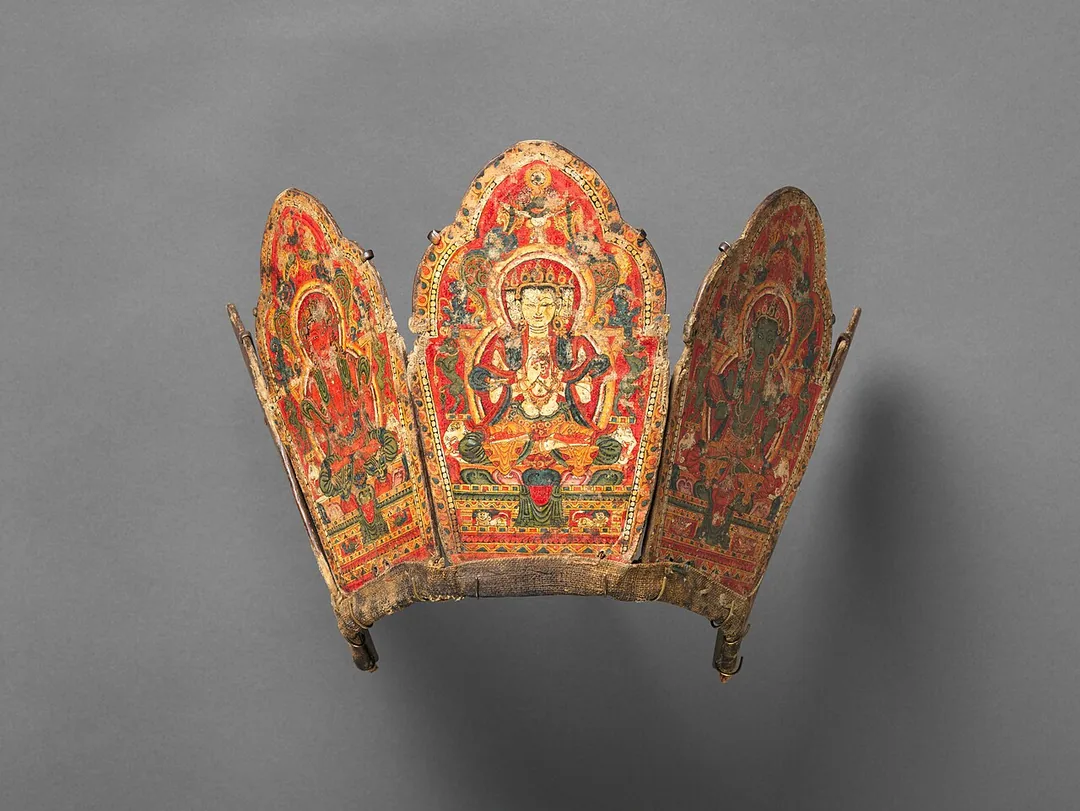
The Five Buddha Families & Five Wisdoms (Rigs-lnga)
Known in Tibetan as Gyalwa Rig-nga, the Five Buddha Families organize every mandala color, direction, element, and deity around one radical psychological premise: the raw energy inside our five most painful emotions is the exact same energy as the Five Awakened Wisdoms.
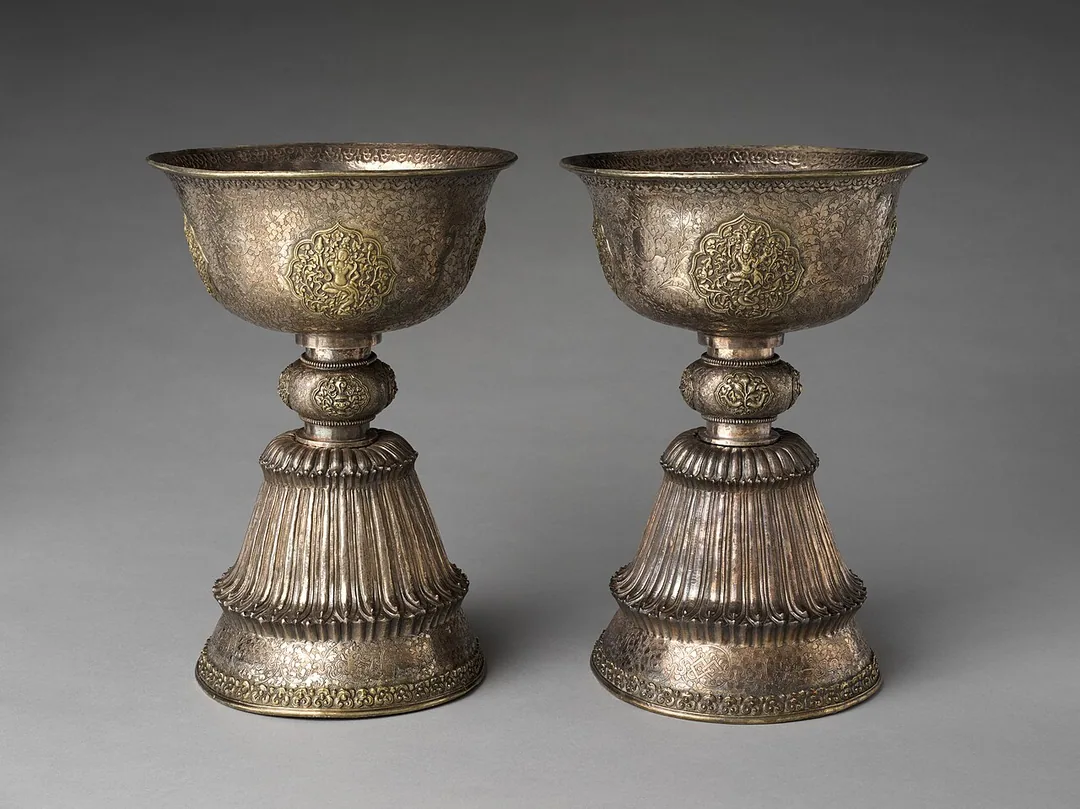
Butter Lamps & Seven Water Bowls (Chöme & Yönchab)
Across every Tibetan household shrine, a straight row of seven brass bowls filled with fresh morning water (yönchab) sits beside warm golden butter lamps (chöme)—chosen precisely because water is free of stinginess and flame dispels darkness without discrimination.
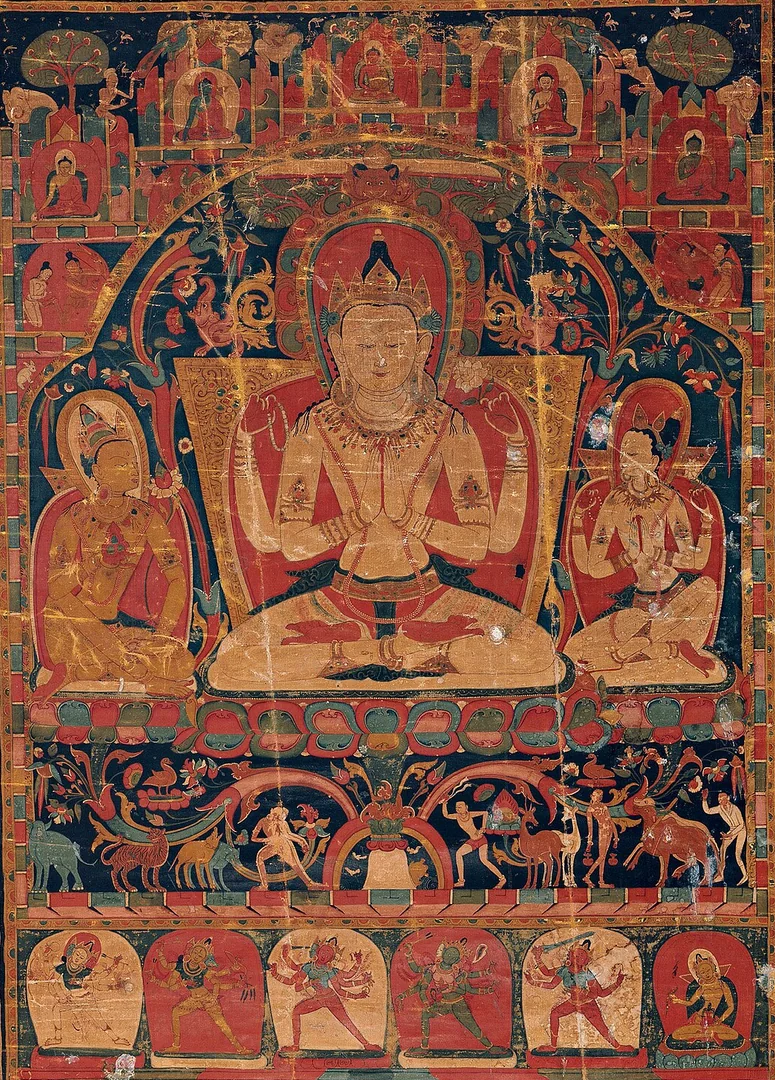
Avalokiteśvara (Chenrezig)
Known in Tibetan as Chenrezig (“One Who Gazes with Unwavering Eyes”), the four-armed white form embodies impartial compassion united with emptiness, associated with the Six-Syllable Mantra Oṃ Maṇi Padme Hūṃ.
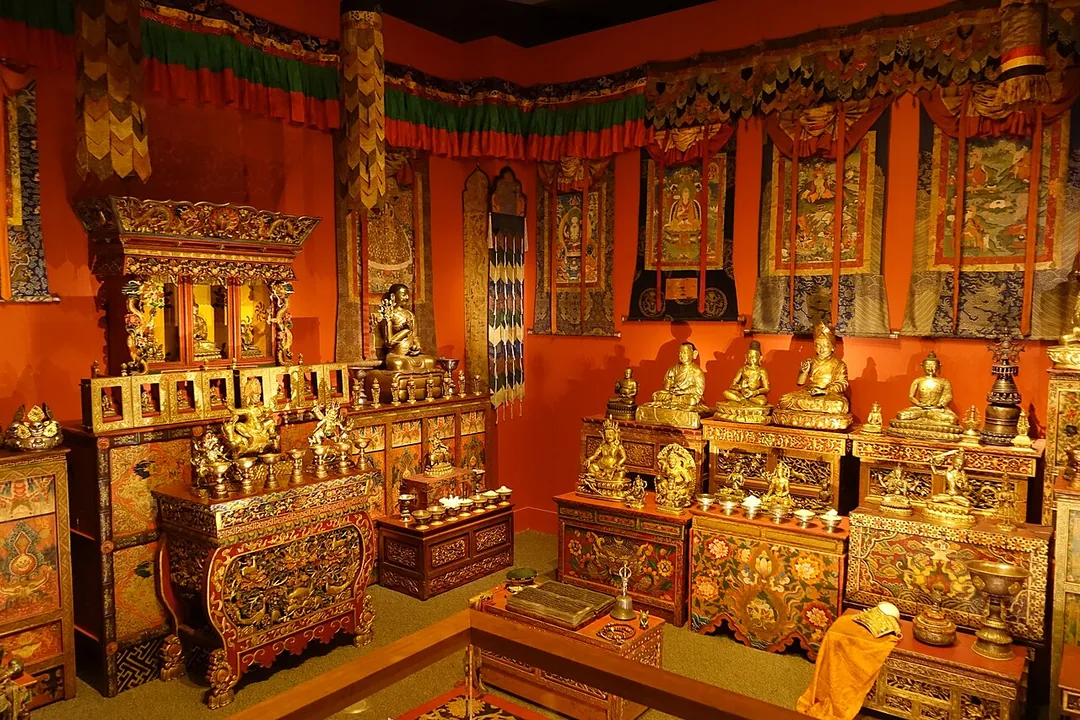
Dedication of Merit (Bsngo-ba · 回向)
No Tibetan contemplation, sutra reading, or prayer-wheel turn ends abruptly; it concludes with bsngo-ba (“turning toward”)—deliberately widening a private wish so everyone walking the same hard road is included.