Vajra & Bell (Dorje & Drilbu · རྡོ་རྗེ་དང་དྲིལ་བུ།)
Why Vajrayāna Takes Its Very Name from This Indestructible Pair
Never separated on a Tibetan altar, the brass five-pronged vajra held in the right hand embodies indestructible compassionate method (upāya), while the hollow bronze bell held in the left proclaims wisdom realizing emptiness (prajñā).
From Indra’s Thunderbolt to the Diamond of Non-Dual Mind
In ancient Vedic myth, the vajra was Indra’s open-pronged thunderbolt weapon; Buddhism radically reimagined it by fusing “thunderbolt” (irresistible clarity) with “diamond” (the Tibetan translation rdo-rje, “Lord of Stones,” which cuts every gem yet cannot itself be scratched). Notice that on a peaceful Tibetan vajra, the four outer prongs curve inward out of makara sea-dragon mouths to meet the central axis—forming a closed crown rather than outward-stabbing spears.
Every millimeter of a standard five-pronged vajra encodes the mandala: the central sphere (bindu) represents non-dual Dharmadhātu; flanking eight-petaled lotuses represent samsara and nirvana in equilibrium; the upper five prongs represent the Five Buddha Families and Five Wisdoms, mirrored below by the purified five aggregates.
| Component / Form | Visual Feature | Philosophical Symbolism |
|---|---|---|
| Central Sphere (Thig-le) | Round hub at center of vajra | Indivisible Ultimate Reality (Dharmakāya) beyond duality |
| 5-Pronged Vajra | 1 central shaft + 4 curving outer prongs | Five Poisons transmuted into the Five Awakened Wisdoms |
| 9-Pronged Vajra | 1 central shaft + 8 directional prongs | Five Buddhas + Four Mothers (or Nine Yānas of Nyingma) |
| Crossed Vajra (Viśvavajra) | Four colored heads meeting at center | Unshakeable foundation & Amoghasiddhi’s fearless action |
| Bell Face & Hollow Dome | Prajñāpāramitā face on handle + resonant bronze dome | Sound arising vividly yet empty of graspable substance |
How It Is Practiced in Living Tradition
Crossed at the heart in the Vajrahumkara mudra during liturgies to signify that compassion without wisdom is blind, and wisdom without compassion is cold.
Common Questions & Clarifications
Why must you never place the bell atop the vajra or separate them far apart?
Traditional samaya etiquette keeps vajra and bell side by side on a cloth cushion—never leaving one behind or carelessly stepping over them—honoring the inseparability of method and wisdom.
Primary Sources & Further Reading
- Robert Beer, The Encyclopedia of Tibetan Symbols and Motifs (Shambhala)
Connected in the Mandala Graph
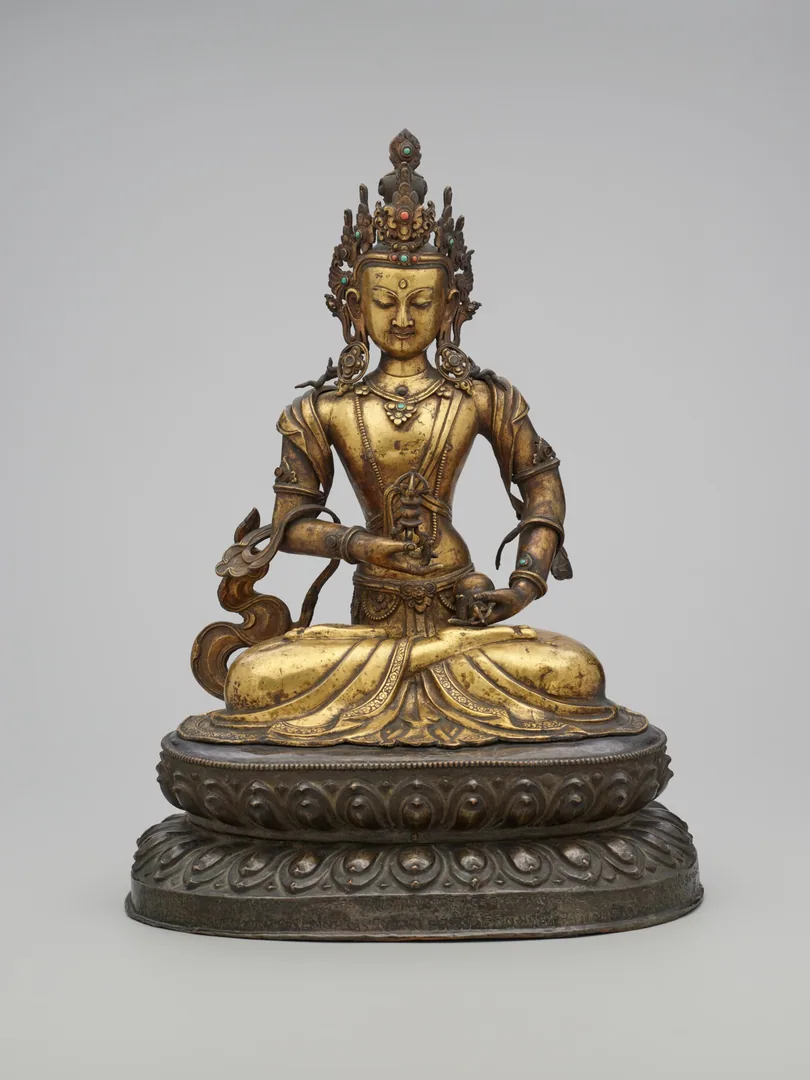
Vajrasattva (Dorje Sempa)
Radiant crystal-white in sambhogakāya ornaments, holding a five-pronged vajra at his heart and a silver bell at his hip, Vajrasattva embodies the indestructible purity underlying transient human mistakes.
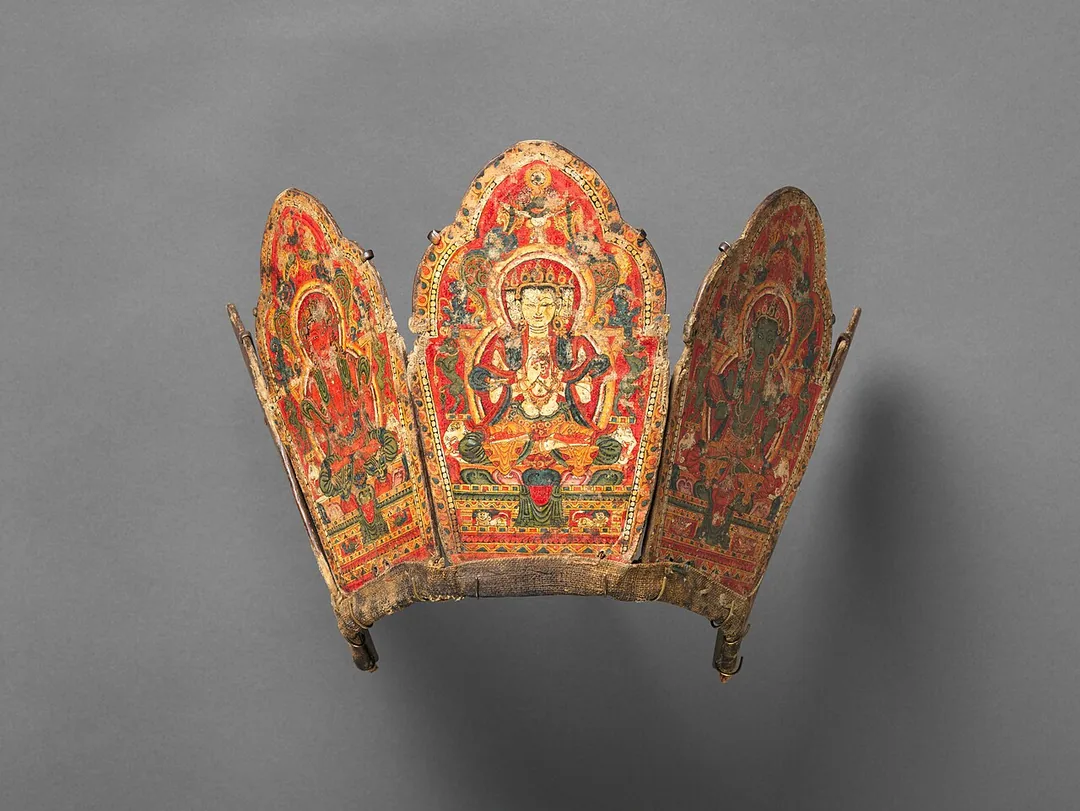
The Five Buddha Families & Five Wisdoms (Rigs-lnga)
Known in Tibetan as Gyalwa Rig-nga, the Five Buddha Families organize every mandala color, direction, element, and deity around one radical psychological premise: the raw energy inside our five most painful emotions is the exact same energy as the Five Awakened Wisdoms.
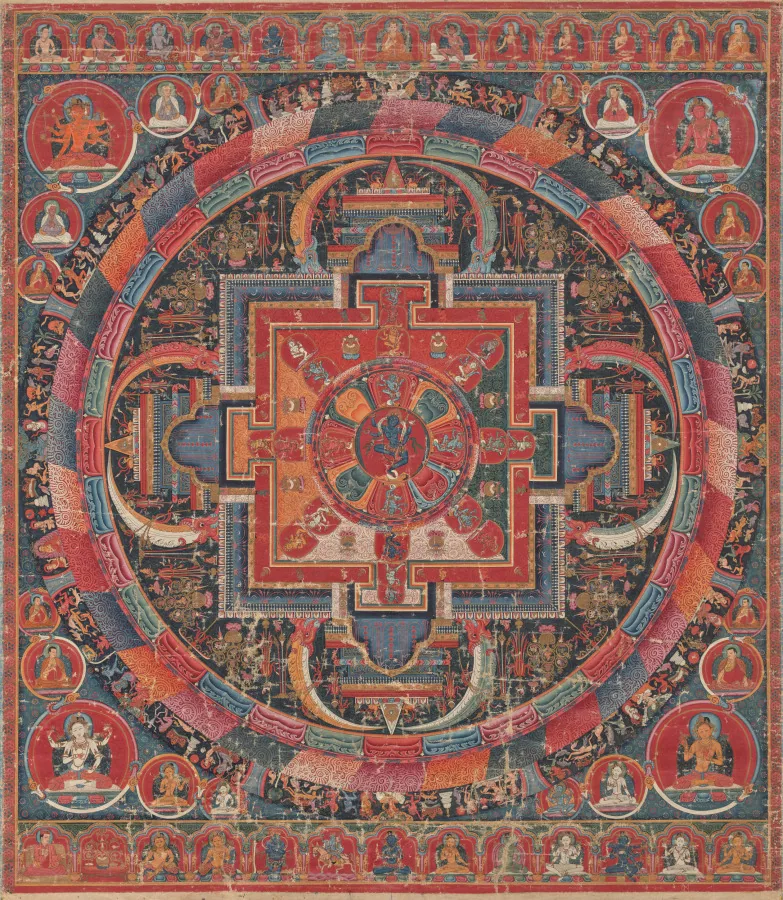
The Mandala (Kyilkhor · དཀྱིལ་འཁོར།)
Rendered in Tibetan as dkyil-’khor (“center and periphery”), a mandala is not decorative symmetry—it is a two-dimensional architectural floor plan of an awakened three-dimensional palace.
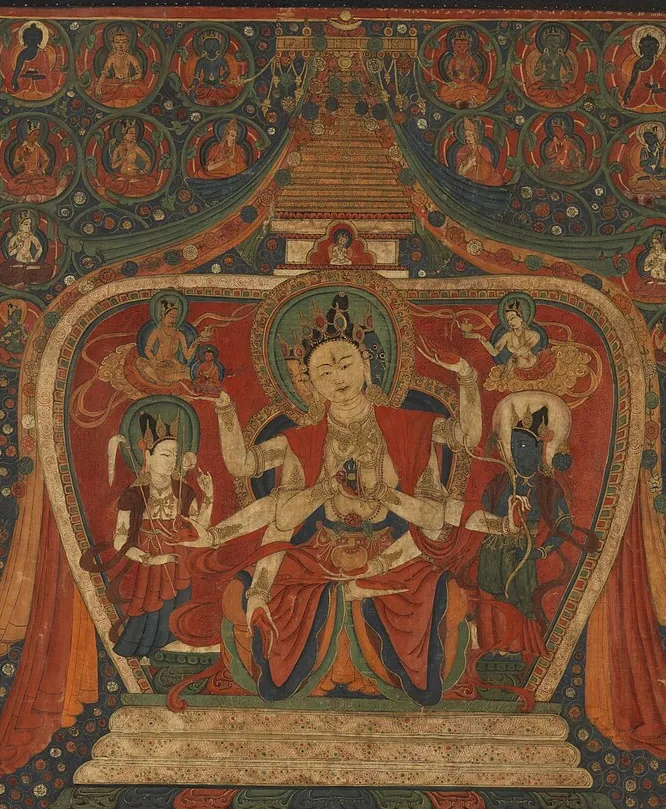
Uṣṇīṣavijayā (Namgyalma · Victorious Crown Wisdom)
Emanating as blinding white light from the crown protuberance (uṣṇīṣa) of Śākyamuni Buddha, three-faced eight-armed Namgyalma unites peaceful healing, protective strength, and karmic purification—completing Tibet’s revered Three Long-Life Deities.