Kṣitigarbha (Sai Nyingpo · “Earth-Treasury” Bodhisattva)
One of the Eight Great Bodhisattvas Bearing the Wish-Fulfilling Jewel & Fertility of Awakening Across Silk Road & Tibet
Literally “Womb or Matrix of the Earth” (Tibetan: Sai Nyingpo), Kṣitigarbha stands among the canonical Eight Great Bodhisattvas (Nye-sras brgyad) surrounding Śākyamuni—revered across Tibet for patient stability, agricultural abundance, and fearlessness in dark passages, while offering a fascinating visual contrast between crowned Tibetan bodhisattva art and East Asian monastic robes.
ཨོཾ་ཀྵི་ཏི་གརྦྷ་བོ་དྷི་སཏྭ་ཡཿ
Devanāgarī: ॐ क्षितिगर्भ बोधिसत्त्वाय · Liturgical Reading: Om kshi-ti-gar-bha bo-dhi-sa-to yah
Oṃ—Homage to Bodhisattva Kṣitigarbha, Earth-Matrix of Steadfast Compassion! (Open Mahāyāna invocation; Tibetan also recites Oṃ Śumbhani Śumbha…)
Why Does Tibetan Kṣitigarbha Wear a Prince’s Crown While East Asian Jizō Is a Monk?
Comparing Kṣitigarbha across Asian museums reveals one of art history’s most illuminating Silk Road stories. In early Indian Mahāyāna sculpture and in the Tibetan Eight Great Bodhisattvas (Nye-sras brgyad—Mañjuśrī, Avalokiteśvara, Vajrapāṇi, Maitreya, Kṣitigarbha, Ākāśagarbha, Sarvanīvaraṇaviṣkambhin, and Samantabhadra, celebrated extensively by Ju Mipham ), all eight bodhisattvas wear royal sambhogakāya crowns and silk scarves. Yet the Ten-Wheel Sūtra (Daśacakra-kṣitigarbha, Toh 64; Xuanzang’s Chinese T. 411) explicitly praises Kṣitigarbha for manifesting in the humble robes of a śramaṇa (monastic mendicant) to guide beings through turbulent eras when no historical Buddha walks the earth.
Our 10th-century silk banner from Mogao Cave 17 at Dunhuang (Musée Guimet MG 17662, painted right after the Tibetan Imperial Btsan-po period at Dunhuang!) captures the exact historical bridge between those two worlds: Kṣitigarbha sits inside a rainbow sphere wearing the Central Asian traveler’s hooded cape (beimao 被帽) over monastic robes while holding the six-ringed khakkhara staff and wish-fulfilling gem.
| Tradition | Attire & Crown | Primary Attributes | Core Cultural Emphasis |
|---|---|---|---|
| Tibetan Vajrayāna (Nye-sras brgyad) | Crowned bodhisattva prince (golden, yellow, or white) | Flaming cintāmaṇi jewel on lotus, sprouting wish-tree fruit, or bell | Earth-element stability, patience, healing depleted earth/harvest vitality (sa-bcud) & bardo guidance |
| Tibetan Ten-Wheel Monastic Variant | Saffron/crimson monastic robes (following Toh 64) | Begging bowl & alarm staff or jewel | Honoring monastic ethical vows (prātimokṣa) as the bedrock of awakening |
| Dunhuang & East Asian (Dizang / Jizō) | Silk Road hooded cape (beimao) or bare shaved monastic head | Six-ringed khakkhara staff (sounding wakefulness) & luminous pearl | Fearless vow illuminating dark realms, travelers & deceased loved ones |
Replenishing the Earth’s Vitality (Sa-bcud) & Peace in Bardo Transitions
In Tibetan ecology and contemplative ritual, Kṣitigarbha holds a uniquely timely role: he is the principal bodhisattva invoked in sa-bcud bum-sgrub (“Earth-Essence Treasure Vase” consecrations) to restore exhausted soil, watersheds, and agricultural balance across fragile high-altitude valleys. And in the Bardo Thödol (Peaceful and Wrathful Deities mandala), white/yellow Kṣitigarbha appears on the Third Day alongside Ratnasambhava—reminding consciousness that pride and scarcity dissolve into the generous equanimity of the earth.
How It Is Practiced in Living Tradition
Openly recited across Mahāyāna and Tibetan traditions—especially in Ju Mipham Rinpoche’s treasury of the Eight Great Bodhisattvas, during environmental earth-healing vase consecrations, and in prayers dedicating peace and safe passage to departed family members (such as parents and elders).
Common Questions & Clarifications
Did Tibetan Buddhism translate the Chinese “Sūtra of the Past Vows of Kṣitigarbha” (Dizang Benyuan Jing)?
Great textual question! The classical Derge Kangyur preserves the older Indian Ten-Wheel Sūtra of Kṣitigarbha (Daśacakra-kṣitigarbha, Toh 64, first translated during the Tibetan Empire from Sanskrit) and esoteric Kṣitigarbha dhāraṇīs (Toh 639), while the Past Vows Sūtra (T. 412) circulated primarily in Chinese, Khotanese/Central Asian fragments, and later Qing/modern Tibetan translations—making the two canons wonderful historical complements.
Primary Sources & Further Reading
- Ārya-daśacakra-kṣitigarbha-nāma-mahāyānasūtra (Ten-Wheel Sūtra of Kṣitigarbha, Kangyur Toh 64), 84000: Translating the Words of the Buddha
- Zhiru Ng, The Making of a Savior Bodhisattva: Dizang in Medieval China & Dunhuang Silk Road Art (University of Hawai‘i Press, 2007)
- Musée national des arts asiatiques – Guimet, Paris (MG 17662): 10th-Century Dunhuang Silk Painting of Kṣitigarbha (Mogao Cave 17)
Connected in the Mandala Graph
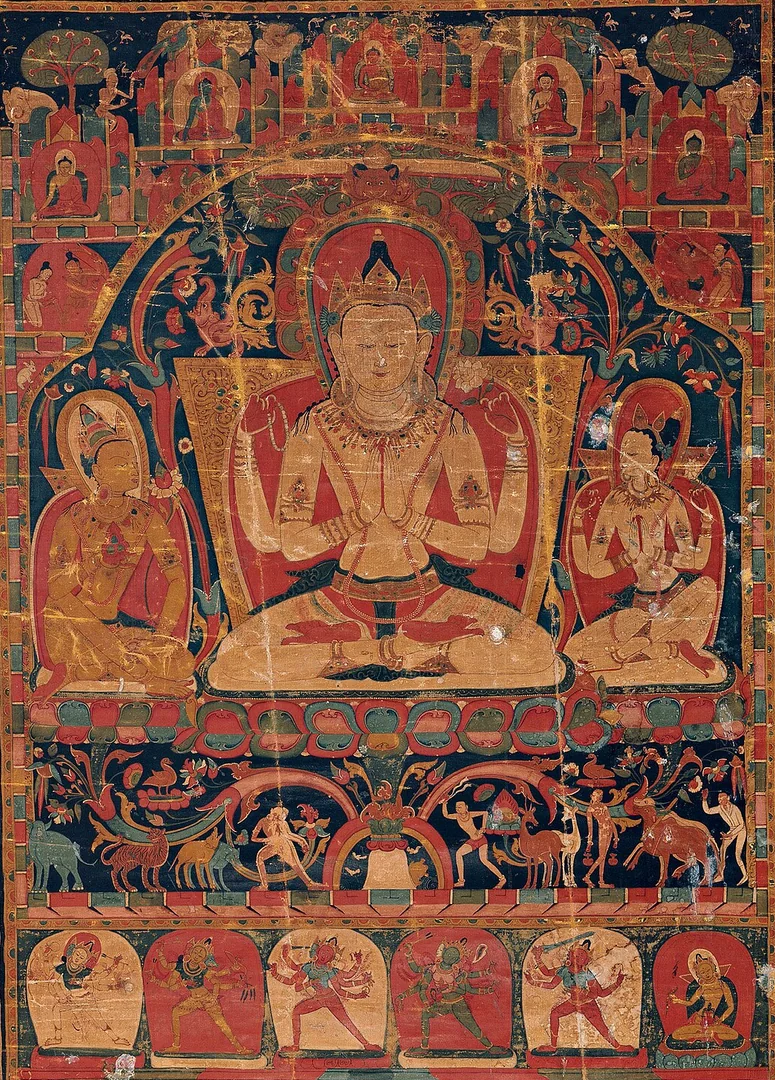
Avalokiteśvara (Chenrezig)
Known in Tibetan as Chenrezig (“One Who Gazes with Unwavering Eyes”), the four-armed white form embodies impartial compassion united with emptiness, associated with the Six-Syllable Mantra Oṃ Maṇi Padme Hūṃ.
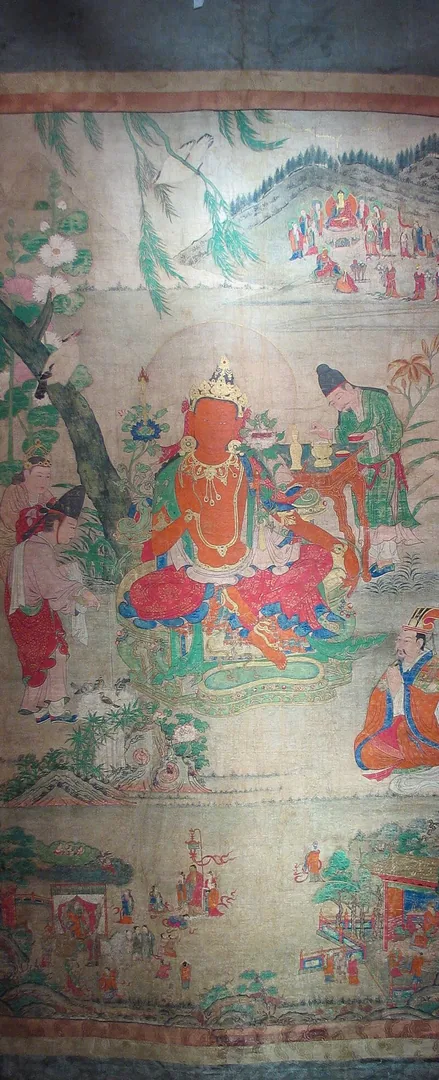
Mañjuśrī (Jampelyang)
Radiant saffron-gold in hue, Mañjuśrī raises a blazing sword overhead with his right hand to slice right through conceptual confusion, while holding the Prajñāpāramitā Sūtra on a lotus at his heart.
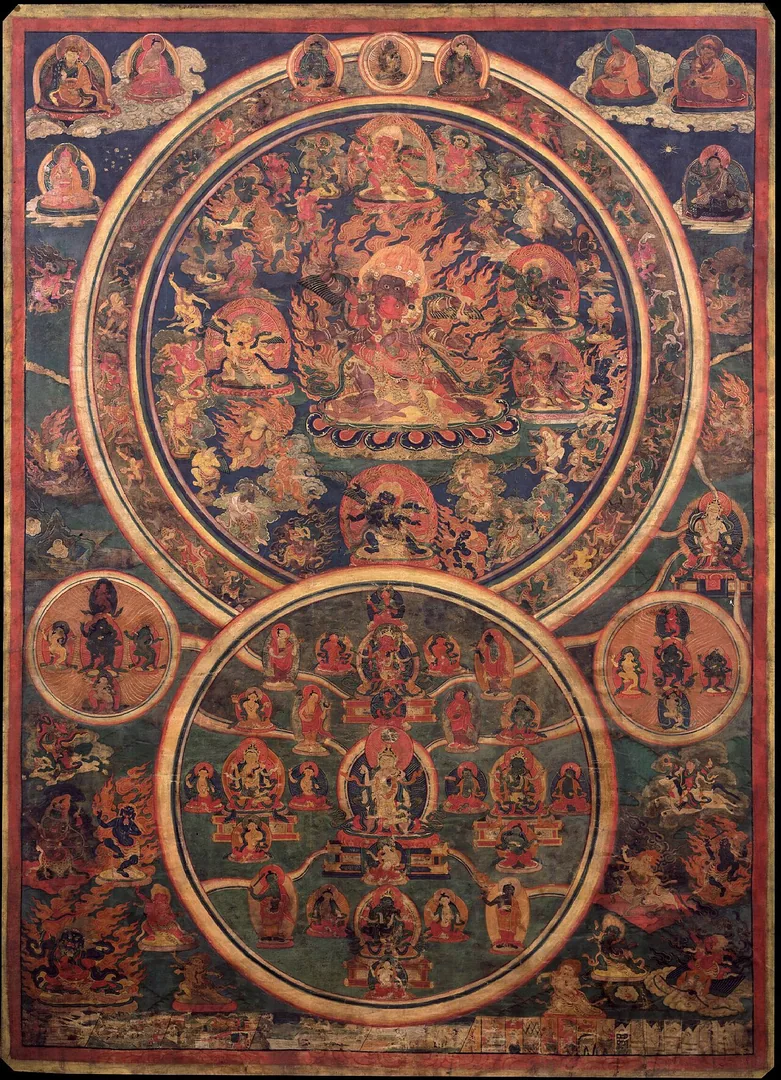
Bardo: The Six In-Between States
Literally “interval between two things” (bar-do), the famous Tibetan Book of the Dead (Bardo Thödol) maps not only death and rebirth, but six everyday transitional spaces—starting with this waking moment.
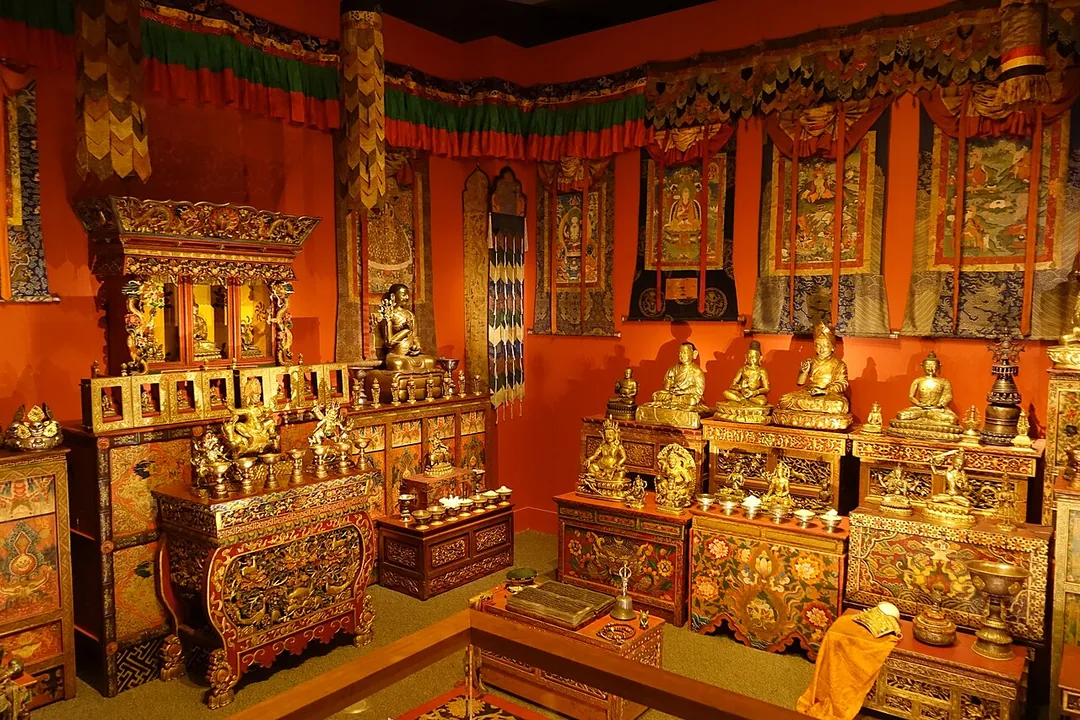
Dedication of Merit (Bsngo-ba · 回向)
No Tibetan contemplation, sutra reading, or prayer-wheel turn ends abruptly; it concludes with bsngo-ba (“turning toward”)—deliberately widening a private wish so everyone walking the same hard road is included.